
Why Social Media Myths Spread So Easily
Social media changes faster than most small business owners can realistically keep up with. What worked even a year ago may not produce the same results today.
At the same time, much of the advice that I see circulating online is based on large brands with dedicated teams, large budgets, and audiences that behave very differently from those of local businesses.
Industry research from platforms like HubSpot, Hootsuite, and Sprout Social consistently shows that results vary significantly based on audience behavior, business size, and content strategy. When advice is applied without context, it creates unrealistic expectations—and often frustration when results don’t follow.
Not sure which of these myths you’re still believing? Take the Social Media Myth Busters Quiz and find out.
Myth #1: Video Always Outperforms Everything Else
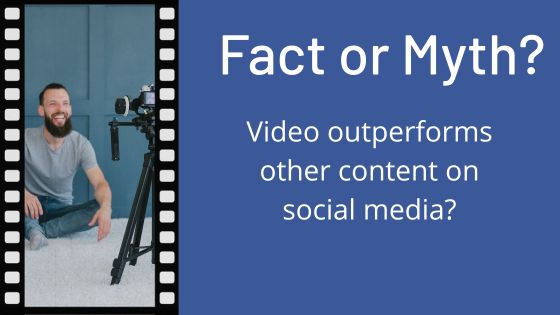
Short-form video is heavily promoted across nearly every social media platform, which has led many business owners to believe it is the most effective format across the board. For example, Facebook plops a band of Reels right in the middle of your feed, and how often do you find yourself hooked on those 3-second shuffles and clicking?
However, platform promotion does not always translate to stronger audience engagement. Many platforms count a video view after just a few seconds, meaning someone scrolling past your content may still be counted as a viewer even if they spent virtually no time with your content.
Industry data from sources like Rival IQ shows that engagement rates vary widely by industry and platform, and static images or carousel posts often outperform video depending on audience behavior.
When Video Works Best — Video can help build familiarity, demonstrate expertise, and showcase personality. The most effective strategies use a mix of content formats rather than relying on a single approach.
Myth #2: You Should Post at the Same Time Every Day
Posting at the same time every day is often recommended, but in practice it can limit reach. Your audience logs in at different times throughout the day. Posting at only one time can mean consistently missing portions of your audience.
Research from Buffer indicates that optimal posting times vary significantly depending on audience and industry.
What Matters More Than Posting Time — Consistency, useful content, and testing different time slots will provide more effective engagement than rigid scheduling. Another hint: use the platform data to see when your audience is most active and schedule your content accordingly.
Myth #3: Facebook Is Dead
Despite many suggestions that Facebook’s popularity is declining, it remains one of the largest and most active platforms, particularly for local businesses. For targeted marketing at prices small business owners can afford, it remains one of the best platforms for small businesses. Geographic targeting can be especially effective at a moderate cost.
Why Facebook Still Works for Local Businesses — Facebook continues to be effective for community engagement, local groups, events, and service-based businesses.
Myth #4: You Must Post Every Day to Succeed
Posting frequency matters less than posting quality. Daily posting without strategy often leads to lower-quality content and weaker results. And frankly, not all your followers want to see your content every single day if it’s the same message over and over.
Two or three intentional posts per week can outperform daily filler content. Trust me, viewers know when you’re posting just to post. Content matters.
What Matters More Than Posting Frequency — Quality, relevance, and consistency.
Myth #5: The Algorithm Is Hiding Your Posts
Everyone would like to have an excuse for why their content isn’t performing, but it really isn’t a hidden agenda by the platforms. That’s what will get you rewarded with your posts reaching a wider audience. Behind the scenes AI bots are looking for specific triggers, and, unless you’re in a sensitive or restricted industry, that is unlikely to happen to you. It’s easy to assume poor performance is due to the algorithm, but platforms prioritize content that receives early engagement.
Meta has confirmed that engagement signals such as likes, comments, and shares influence distribution. If you want to drive more engagement, start with quality content and respond and interact with anyone who engages. That’s what will get you rewarded with your posts reaching a wider audience.
How the Algorithm Actually Works — Platforms prioritize content that receives early engagement.
Myth #6: Audio Is Essential to Video Performance
Many users scroll with sound off, especially on mobile devices. Let’s face it, a lot of people are keeping one eye on the meeting they are in and one eye on their phones. Or they are in a waiting room at the dentist. Or their partner is asleep. Regardless of the situation, their phones are on silent. If your content relies on audio alone, a large portion of your audience may miss your message. Captions and strong visuals are essential. If your message relies on sound, most people won’t hear it.
What This Means for Your Content — Captions and strong visuals are essential.
Myth #7: Hashtags No Longer Matter
Hashtags still help categorize content and improve discoverability when used intentionally. People do search platforms for specific content that they are interested in. With the right hashtags, you might draw in new followers. If you don’t use hashtags at all, you significantly limit your chances of being discovered.
Effective hashtags focus on relevant industry, geography, and niche hashtags rather than large volumes of generic tags. Broad hashtags rarely reach the intended audience.
How Hashtags Still Help — Hashtags still help categorize content for platform users.
Myth #8: Social Media Should Immediately Generate Sales
Social media is often expected to drive immediate sales, but that’s rarely how it works—especially for small businesses.
If you are a social media manager, you have undoubtedly had clients ask why they should pay for social media (in other words, why pay you) if they’re not seeing sales. I just had a client say this. I had him do a search for his business. Two of his social media platforms showed up on the first page of that search because social media presence builds visibility.
Most people are not ready to buy the first time they see your content. They are becoming familiar with your business, getting a sense of your credibility, and deciding whether they trust you.
Research from Google shows that purchasing decisions typically involve multiple touchpoints before conversion. Social media is often one of the first—not the last—of those interactions.
If your strategy focuses only on immediate sales, you miss the opportunity to build the awareness and trust that actually lead to conversions. Social media doesn’t usually drive the first sale—but it often influences the decision.
Where Social Media Actually Fits — Social media is often one of the first—not the last—touchpoints in customer decision-making.
Myth #9: You Need Thousands of Followers to Succeed
More followers do not automatically translate into customers. This is one worth repeating; followers are not necessarily buyers.
I’ve seen accounts with thousands of followers generate little to no real engagement, while smaller accounts consistently bring in inquiries and actual business.
There are brands with large followings that see strong results, but they typically already have brand awareness, larger advertising budgets, and teams dedicated to managing and optimizing their social media. That’s not the reality for most small, family-owned businesses.
Without engagement, trust, and a clear path to conversion, a larger audience may have no impact on your bottom line. More followers won’t fix weak engagement. No engagement, no conversions.
What Actually Drives Results — Engagement and trust.
The Real Secret to Social Media Success
The short answer is that there is no single tactic that guarantees success on social media. What works is understanding your audience, creating content that is actually useful to them, maintaining consistency, and building trust over time. That means letting go of the idea that more posts, more platforms, or more followers automatically lead to better results.
The businesses that see the strongest return from social media are not doing everything—they are doing the right things, consistently, with a clear strategy behind them.
If you’ve found yourself questioning whether what you’re doing is working, you’re not alone. Social media can feel overwhelming, especially when the “rules” keep changing. If this helped clarify a few things or gave you a different way to look at your strategy, that’s the goal. And if you ever want a second set of eyes on what you’re doing, AZ Media Maven is always here as a resource.
If you haven’t taken the Social Media Myth Busters Quiz yet, it’s a quick way to see how your current approach stacks up.
AZ Media Maven is based in Laveen, AZ, a suburban village in the greater Phoenix area. Owner Rose Tring has more than 30 years of journalism experience as an editor and writer, many of those years in business news. She created AZ Media Maven in 2012 to help other business owners succeed by effectively telling their stories through public relations, social media, and digital marketing. Reach AZ Media Maven at azmediamaven@azmediamaven.com or call (602) 373-8371.