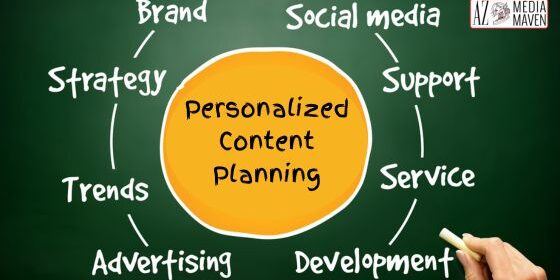
Everything about the digital world feels noisy, fast, and strangely impersonal. However, personalizing your approach to content strategy can cut through the chaos. Being personal creates a sense of intimacy that helps people feel seen, understood, and valued. Businesses that master personalizing content build loyalty that lasts.
Personalization doesn’t rely on trying to beat the algorithms. Instead, personalized content strategies are about empathy on a scale. The best strategies combine data insight + content structure + channel awareness. As a small business start small by mapping the start small by mapping your audiences, matching their needs and identifying the platforms where they spend their time.
Why personalization matters more than ever
We’ve entered the attention recession. Everyone’s swiping, scrolling, skipping. A one-size-fits-all content approach doesn’t stand a chance at catching attention. Personalization, though, when rooted in genuine understanding and empathy boosts these three things:
Relevance → users see content that fits within their experience
Engagement → higher click-through and conversion rates
Retention → people come back for experiences that “get them”
According to HubSpot’s State of Marketing 2024 report, businesses that leverage personalization see engagement increase by up to 55%, especially in email campaigns and website experiences.
How personalization works
| Stage | Focus | What to Do | Example |
| Discover | Understand your audience | Analyze behavior, surveys, and CRM data | Use Google Analytics segments |
| Segment | Group users by need or journey | Create personas and clusters | Example: “First-time visitor” vs. “Returning subscriber” |
| Adapt | Match message to context | Adjust tone, offer, visuals | Send different headlines via Mailchimp A/B tests |
| Deliver | Automate smartly | Use dynamic content modules | Leverage Salesforce Marketing Cloud or similar tools |
| Refine | Measure & optimize | Track CTR, dwell time, conversions | Use dashboards in Databox or Looker |
The key to consistent engagement: unified experiences
Modern customers jump between channels—mobile, web, social, even smart devices—expecting a seamless journey. That’s where a platform designed for unified delivery shines. Building an omnichannel customer experience helps businesses manage and distribute content across all digital touchpoints from a single hub.
With multisite management, every channel stays consistent in branding while still personalizing for local context or customer type. Plus, integration with other tools syncs content and data—ensuring your message, metrics, and media work in harmony.
How to launch a personalization program
- Audit your current content. Identify what’s generic or repetitive.
- Map audience segments. Start with 3–5 clear persona types.
- Create modular content. Write flexible blocks that adapt by audience.
- Automate smartly. Use personalization tags, not 1:1 manual edits.
- Test early, optimize often. Run A/B and multivariate experiments.
- Review cross-channel consistency. Brand tone should feel unified, not duplicated.
- Document the process. A playbook helps new team members scale your system.
Turn engagement data into strategy
Sometimes the gap isn’t in creativity, it’s in visibility. Tools like Hotjar and Crazy Egg reveal how people really interact with your content. Heatmaps and scroll-tracking expose where users drop off, helping you design more engaging experiences.
Combine that withCanva templates for rapid content production, and you’ve got a repeatable system that feels personal—without overwhelming your team.
FAQs: Common questions about personalization
Q1: How much data do I need to personalize content?
Start simple. Even location, device type, or referral source can make content feel personal.
Q2: Isn’t this too technical for small teams?
Not anymore. Platforms like Notion or Trello can manage simple content rules before you invest in full-scale systems.
Q3: What if personalization feels “creepy”?
Respect privacy. Always disclose data use and avoid overly specific messaging that feels invasive.
Q4: How often should I refresh my personalization rules?
Quarterly works for most brands—align updates with major campaigns or seasonality shifts.
The personalization reality checklist

- We know who our core audience segments are
- We have analytics data tied to content performance
- Our CMS supports dynamic content or tagging
- Brand tone is consistent across all channels
- We test, learn, and refine regularly
- Personalization aligns with business goals, not just novelty
If you can’t tick most of these, start small—pick one segment and build from there.
Glossary
- Segmentation — Dividing your audience by shared traits or behaviors.
- Dynamic content — Website or email elements that change automatically based on user data.
- Omnichannel — A coordinated presence across all digital touchpoints.
- Persona — A fictional profile representing a real audience segment.
- Conversion rate — The percentage of users who take a desired action, like a signup or purchase.
- Journey mapping — Visualizing customer steps from discovery to purchase.
- A/B testing — Comparing two versions of content to see which performs better.
Product spotlight: A useful tool
If your team struggles with visual organization, Miro makes it easy to map audience journeys and collaboration flows in real time. It’s not about design—it’s about seeing your personalization logic laid out clearly.
Conclusion
Personalization is a craft, not a campaign. The best systems evolve through listening, testing, and fine-tuning. Start with clarity, scale with structure, and never forget the human on the other side of the screen.
AZ Media Maven is based in Laveen, AZ, a suburban village in the greater Phoenix area. Owner Rose Tring has more than 30 years of journalism experience as an editor and writer, many of those years in business news. She created AZ Media Maven in 2012 to help other business owners succeed by effectively telling their stories through public relations, social media, and digital marketing. Reach AZ Media Maven at azmediamaven@azmediamaven.com or call (602) 373-8371.